

Heat is the one thing that cannot hide from the sky.
Ironbow is the name of a thermal palette: the color scale by which military targeting pods translate temperature into image — cold rendered as deep indigo and violet, heat rising through red and orange to a blinding yellow-white. It is not an artist’s palette. It is an instrument’s, engineered for vigilance, so that a warm thing in a cold world cannot fail to be seen. The declassified record is full of what this palette was built to catch: in one released mission report, a gunship crew tracked some two dozen “cold orbs” moving in formation over the Gulf of Oman; in another, agents described small spherical objects “able to change directions quickly and simultaneously.” These paintings adopt the instrument’s palette whole, and fill it with the record’s recurring subject — lights, grouped, moving together, unresolved.
Cold is the ground condition of these paintings. Heat is the event. The signatures are built from beneath — luminous cores glazed in transparent reds and oranges, so each light burns inside the field rather than resting on it. The first plates in the series are painted over the bodies of earlier works: gridded canvases from a previous series, drowned under layered darkness, their lattices surviving as faint structure ghosting through the black — the way a sensor picks up residual warmth, a signal older than the instrument, not quite recoverable. Others begin on new, smooth panels, where the field carries no memory at all. The two grounds answer each other: some skies have a past, and some are blank.
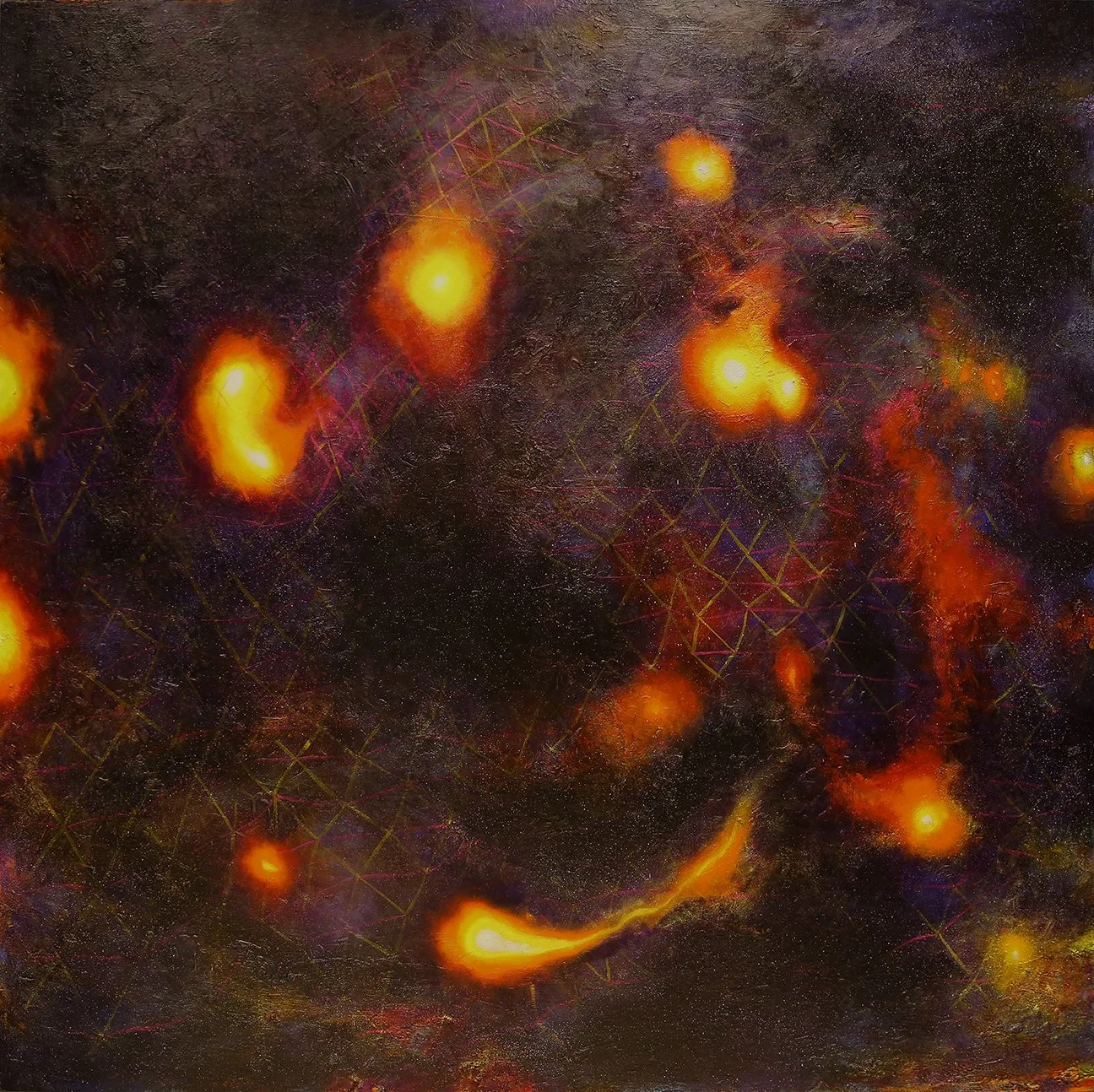
Able to Change Directions Quickly and Simultaneously — oil on canvas over earlier painting, 72×72" (183×183 cm), 2026 (source: Department of War mission report, Middle East, July 2025 — “six small spherical objects grouped together... able to change directions quickly and simultaneously”)